



How often does Thurston County require a septic inspection?
A septic inspection in Thurston County is due every three years for a system that is only a tank and a gravity drainfield, and every year for every other type, under Article IV of the county Sanitary Code. The inspector files the report online within 30 days. If your system carries an Operational Certificate, the county mails a renewal packet about two months before it is due.
Street to Drainfield · updated · sources listed at the end
How often does the Sanitary Code call for an inspection?
The interval follows the type of system. Article IV of the Thurston County Sanitary Code, effective 1 April 2025, sets once every three years for a system made up solely of a septic tank and a gravity drainfield, and once a year for all other systems unless a certificate or maker asks for more. Washington's statewide rule, WAC 246-272A-0270, uses the same two intervals. Pressure distribution, mound and sand filter systems therefore fall in the yearly group.
What is an Operational Certificate, and does your system need one?
An Operational Certificate, or OPC, is a renewable county permit that ties a system to set inspection and maintenance conditions. Article IV requires one for mounds, intermittent and stratified sand filters, drip lines, disinfection units, proprietary treatment products, holding tanks, community systems and systems serving food businesses. Every system in a designated marine recovery area needs one too; in the Henderson and Nisqually Reach areas the charge appears as a line on the property tax statement. Not every system in the county has a certificate, according to the county's homeowner requirements page.
Who is allowed to inspect a septic system here?
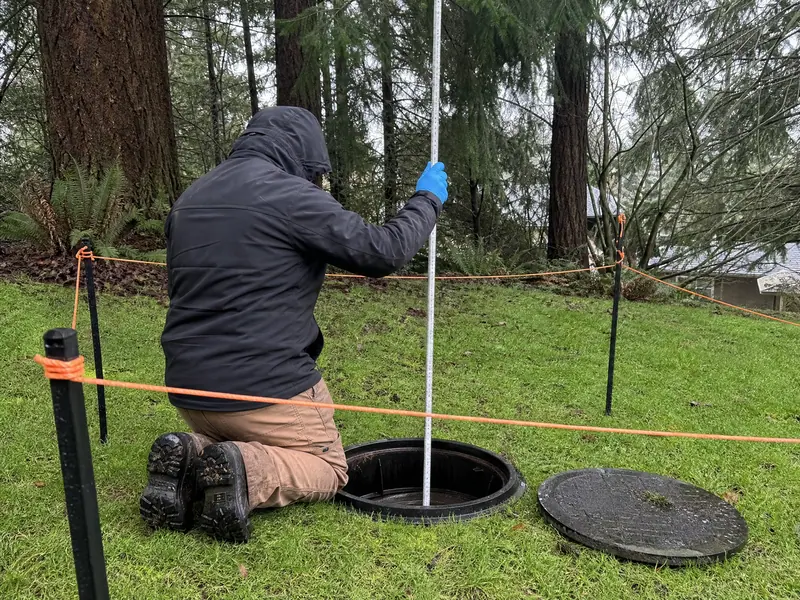
Inspections are done by septic professionals certified by Thurston County. The county's hiring page explains that monitoring specialists can inspect every type of system, while pumpers inspect and pump tanks and make minor repairs. Systems with a proprietary product may be inspected only by professionals the department has certified. The county also trains some owners of gravity, pressure and mound systems as self-inspectors, warns that work around open tanks "can lead to illness, injury, and death," and from 1 January 2026 requires those owners to get a certified professional's inspection every 9 years. This site's advice is to leave opening lids and measuring to a county-certified pumper or monitoring specialist, and never to open a lid alone.
What does the inspector check?
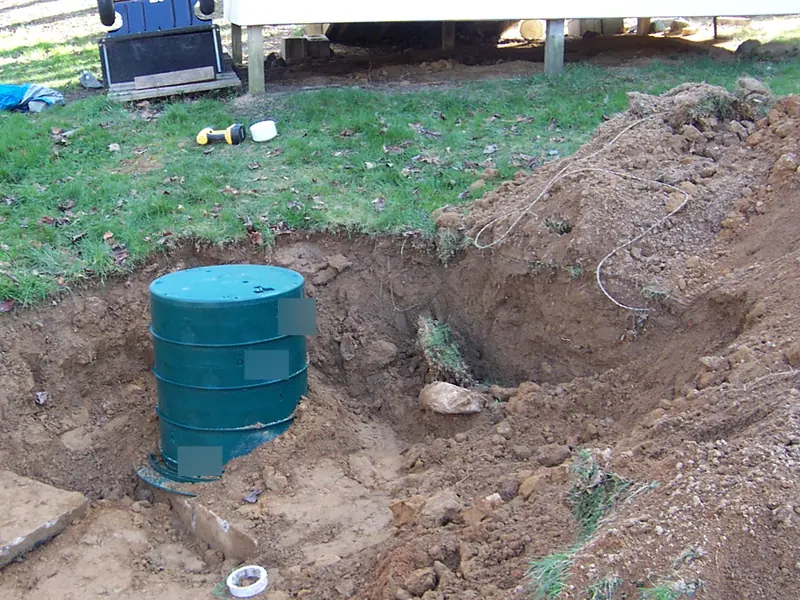
A full inspection covers every part of the system, not only the tank. Article IV lists scum and solids levels in tanks and pump chambers, plus lids, baffles, walls, floors, effluent screens, risers and riser locks. EPA's septic questions page adds a records review, signs of leaks or backup staining, pumps, controls and wiring, the distribution box, and the drainfield surface. Pumping is a separate service; the county says a pump-out is not a substitute for an inspection.
Where does the report go, and what does it cost to file?
Reports go to OnlineRME, a public database the county uses for septic records. Article IV gives a 30-day window after the inspection. The county's 2026 fee schedule lists an OSS Pumper Report Submission Fee of $20 online or $45 on paper; it is the fee for each pumper or inspection report your professional files. The Operational Certificate renewal fee is $185, or $100 for senior or disabled owners, as that schedule read on 6 November 2026.
What happens if the due date slips?
The county sends a reminder two months before the due date, another a month after it, and a final notice a month later. Four months past the due date, the certificate becomes non-conforming, and getting it back means a current inspection plus any unpaid fees. The county says extensions are often granted when an owner asks, so contact the O&M program through its page before the deadline passes. You can read the past reports for any address through the county's online septic records.
| System type | Inspection interval | Where it is set |
|---|---|---|
| Tank plus gravity drainfield only | Every 3 years | Article IV, Section 16 |
| Pressure distribution or mound | Every year | Article IV, Section 16 |
| Sand filter, drip or proprietary unit | Every year, plus certificate conditions | Article IV, Section 16.B and 16.I |
| Any system at sale | Within 12 months before the transfer application | Article IV, Section 16.K |
Yours to do
- Keep your mailing address current with the Assessor so the renewal packet reaches you.
- Book the inspector as soon as the packet arrives.
- Look up your system's past reports online before the visit.
- Ask for an extension in writing if you need more time.
Leave to a licensed or certified pro
- Opening, measuring and closing every tank and pump chamber.
- Checking pumps, floats, alarms and controls.
- Filing the inspection report within 30 days.
- Collecting samples where the certificate requires them.
On the record
- 3 yearsInspection interval for a tank and gravity drainfield onlyThurston County Sanitary Code, Article IV
- 1 yearInspection interval for every other septic system typeThurston County Sanitary Code, Article IV
- 30 daysDeadline to file the inspection reportThurston County Sanitary Code, Article IV
- $185Operational Certificate renewal fee in 2026Thurston County fee schedule
- 4 monthsAfter the due date, a certificate turns non-conformingThurston County Environmental Health
Common questions
Does a gravity system without a certificate still need inspecting?
Yes. Article IV applies the three-year inspection to every system made up of a tank and gravity drainfield, whether or not it holds an Operational Certificate.
Is a 5% surcharge added to septic fees in 2026?
The county's codes page says a 5% technology fee applies to all county permits and applications from 1 January 2026. Ask Environmental Health whether it applies to your renewal invoice.
Does the inspection tell me whether to pump?
Yes. The inspector measures scum and sludge, and the county says the tank must be pumped only when those layers are thick enough to need it. See how often to pump a septic tank for the one-third rule.
Can I use a Time of Transfer inspection for my certificate renewal?
Often, yes. The county's Time of Transfer page says an inspection and pumping done for a sale can usually renew the certificate if the system works and all requirements are met.
Are there free classes on living with a septic system?
The county runs Septic Sense workshops each September. Check the county events calendar for dates.
Sources
- Thurston County Sanitary Code, Article IV - Sewage Disposal — inspection intervals, certified inspectors, 30-day filing, certificate categories; read 6 November 2026
- Homeowner Maintenance & Requirements, Thurston County — renewal packet, reminders, non-conforming status, self-inspection rule; read 6 November 2026
- Environmental Health 2026 Fee Schedule, Thurston County — $185 and $100 renewal fees, $20 and $45 report fees; read 6 November 2026
- Environmental Health Codes and Regulations, Thurston County — 5% technology fee; read 6 November 2026
- Hiring a Septic Professional, Thurston County — roles of pumpers and monitoring specialists; read 6 November 2026
- Time of Transfer, Thurston County — sale inspection used for renewal; read 6 November 2026
- WAC 246-272A-0270, Washington State Legislature — statewide owner inspection duties; read 6 November 2026
- Frequent Questions on Septic Systems, US EPA — what an inspection covers; read 6 November 2026
How this page was put together. This page is built from the Thurston County Sanitary Code Article IV, the county's 2026 fee schedule and its septic program pages, the state rule in WAC 246-272A-0270, and EPA's septic questions page, all read on 6 November 2026. It leaves out inspection prices charged by contractors, which the county does not publish, and it does not teach the self-inspection procedure; the county runs that course itself.
 Next at this stopHow often should a septic tank be pumped? AI picture