

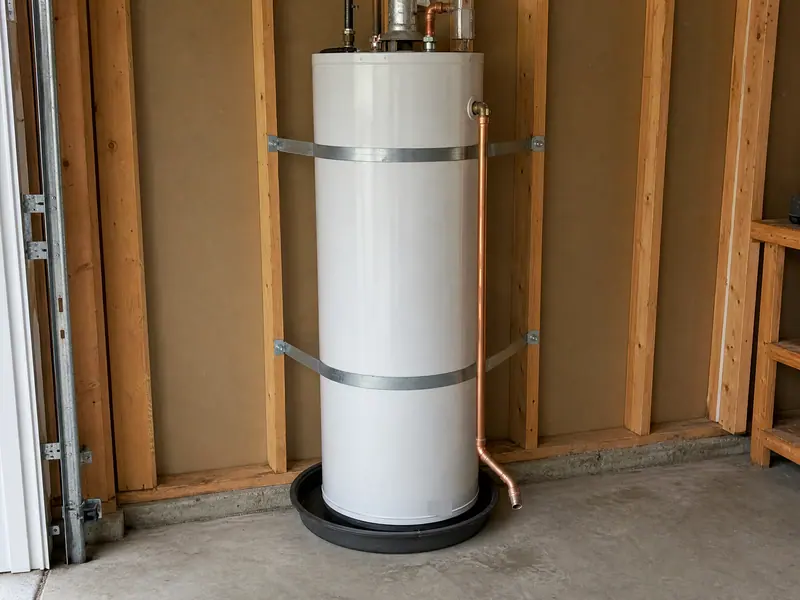


A water heater in the garage or crawlspace
A water heater in a garage has one Washington rule most other spots don't: on a gas or propane heater, burners and ignition sources sit at least 18 inches off the floor unless the heater is listed flammable vapor ignition resistant. In a crawlspace or above finished rooms, the pan and its drain matter most, along with room to reach the controls.
Street to Drainfield · updated · sources listed at the end


Why does a gas water heater in a garage sit 18 inches up?
The height keeps flames and sparks up off the floor of a room where cars, fuel cans and solvents live. Washington's amendments to the plumbing code, in WAC 51-56, say appliances in a garage, or in spaces that open to it, must have burners, burner-ignition devices and ignition sources at least 18 inches above the floor. The exception is a heater listed as flammable vapor ignition resistant, which the rating label will say. If you're not sure which you have, the label and the maker's manual settle it, not a guess.
An electric-model manual published on A. O. Smith's website notes that some local codes want the bottom element raised 18 inches as well, so ask your permit office before you set an electric tank on the slab.
Does a garage water heater need a drain pan?
A pan earns its keep wherever a leak would soak something: a finished room next door, a floor below, or stored boxes. The Rheem electric use and care manual recommends a catch pan, adequately drained, where leakage would cause damage, and says the pan must conform to local codes. The A. O. Smith-hosted manual gives sizes: no deeper than 2-1/2 inches, two inches wider than the heater, and a drain line at least 3/4 inch inside diameter, pitched to a suitable indoor drain. Outdoor drain ends can freeze in a cold snap and back up.
What about a water heater in the crawlspace?
Crawlspace heaters are harder to see, so leaks run longer before anyone notices. A pan with a working drain helps limit that damage, and so does a look every few months with a flashlight; the crawlspace leaks page covers what to look for and how to go in safely. The manuals also ask for room to pull the access panels and reach the drain valve, and for pipes protected from freezing. If a heater sits where you can't reach the panels, that is a job for a licensed plumber, not a reason to work lying on your side.
Where does the relief valve pipe go?
Never into the pan. Washington's amended code, section 608.5, bans relief valve discharge into a water heater pan and wants the pipe full size, pointing down, with an end you can see. Outside, the end must be between 6 inches and 2 feet above the ground. A dripping relief valve is a sign to call a licensed plumber; the A. O. Smith-hosted manual says to have a qualified person replace a leaking one.
Do I need a permit to replace a water heater in Thurston County?
Usually yes, and the office depends on where you live. Lacey's permitting page lists water heater replacement among permits it can issue over the counter. Olympia runs forms, fees and inspection scheduling through its building permits page and permit portal. Outside city limits, Thurston County Permitting and Development issues building permits. Inside Tumwater, ask the city's permit center which permit you need; the City of Tumwater's website is the place to start.
For an electric heater, L&I says electrical work needs a permit and inspection with few exceptions; Olympia and Lacey issue their own electrical permits, and L&I covers the rest of the county.
Who is allowed to do the work?
Under L&I's plumber program, only certified plumbers may do plumbing on someone else's property, while property owners may work on their own. That doesn't cover gas piping, venting or burners, and this page gives no steps for any of them. If you smell gas, don't touch switches or light anything; leave and call 911 and your gas utility or propane supplier from outside. If a CO alarm sounds, get everyone out and call 911 from outside.
Yours to do
- Check the rating label for a flammable vapor ignition resistant listing.
- Keep fuel cans, paint and solvents well away from the heater.
- Look in the pan and around the base for water every few months.
- Keep the access panels and drain valve clear.
Leave to a licensed or certified pro
- Raising, moving or replacing a gas or propane heater.
- Any gas line, venting or burner work.
- Rerouting a relief valve pipe that ends in the pan.
- Adding a pan drain line through a wall or floor.
On the record
- 18 inchesburner and ignition height above a garage floorWAC 51-56
- 6 in to 2 ftrelief pipe end above ground outsideWAC 51-56
- 2-1/2 inchesmaximum pan depth in one maker manualA. O. Smith-hosted manual
- March 15, 2024current plumbing code took effect statewideWAC 51-56-008
| Spot | What matters most | Where to check |
|---|---|---|
| Garage, gas or propane | 18-inch burner height or vapor-resistant listing | WAC 51-56, rating label |
| Garage, electric | Pan, vehicle stop, local element-height rule | Permit office, maker manual |
| Crawlspace | Pan drain, access, freeze protection | Maker manual, permit office |
| Above finished rooms | Pan piped to a drain | Maker manual, local code |
A store to look at
PlumbingSupplyAndMore's water heater pan section is a place to compare pan sizes against your heater's diameter before talking to a plumber. That supply house is run by the same team as this site.
Common questions
Does an electric water heater in a garage need to be raised?
The 18-inch rule in Washington's amendments names burners and ignition sources, which points at fuel-burning heaters. Some local codes go further, so ask your permit office before deciding.
Can the pan drain to the yard?
The A. O. Smith-hosted manual prefers a suitable indoor drain because outdoor ends can freeze. Your permit office has the final say on where it may end.
Is a vehicle stop needed in front of a garage heater?
The maker manual says the heater should sit where moving vehicles can't hit it and shows a stop in its garage drawing. A bumped heater can tear its water or gas connections.
Does a new pan need a permit?
Adding a pan under an existing heater usually involves no change to the heater itself, but a new drain line through walls or floors may. Ask your city or the county before cutting.
Where does strapping fit in?
Every heater in Washington must be strapped, wherever it sits. The earthquake straps page covers the rule and the water heater stop gathers the rest.
Sources
- WAC 51-56, Washington amendments to the 2021 Uniform Plumbing Code — garage height, relief valve discharge, effective date; read 6 November 2026
- Rheem electric residential use and care manual AP21980 — catch pan advice; read 6 November 2026
- Residential electric water heater manual on A. O. Smith's site — pan size, drain, access, vehicle note; read 6 November 2026
- City of Lacey permitting — over-the-counter water heater permits; read 6 November 2026
- City of Olympia building permits — permit portal; read 6 November 2026
- Thurston County Permitting and Development — unincorporated permits; read 6 November 2026
- L&I electrical permits — electrical permit rule; read 6 November 2026
- L&I plumber program — who may do plumbing; read 6 November 2026
How this page was put together. This page rests on Washington's plumbing code amendments, L&I's plumbing and electrical pages, the Lacey, Olympia and Thurston County permit pages, and two maker manuals, all read on 6 November 2026. Tumwater's permit process could not be confirmed, so it is not described. It gives no steps for gas, venting or wiring work, and quotes no permit fees.
 Next at this stopEarthquake straps on a Washington water heater AI picture