

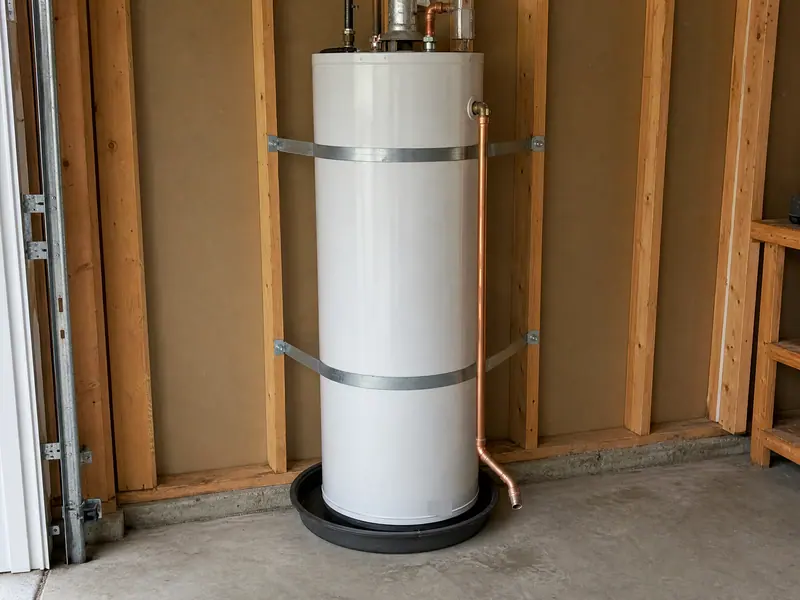


No hot water from an electric water heater
When an electric water heater gives no hot water, the usual causes, in the order makers list them, are no power, a tripped high-limit control, or a failed upper thermostat or element. You can check the breaker and, with the breaker off the whole time, press the red reset. Elements and thermostats are a job for a licensed pro unless your maker's manual covers them.
Street to Drainfield · updated · sources listed at the end


Why is my electric water heater giving no hot water?
The troubleshooting chart in a residential electric manual hosted on A. O. Smith's site lists three causes for no hot water: no power to the heater, an open high temperature limit switch, or a non-working upper thermostat or element. Lukewarm water that runs out fast points more to the lower element or thermostat. A big run of showers can also empty the tank; the Rheem use and care manual says to wait for it to recover after an unusual demand.
Is the breaker tripped?
Start at the electrical panel. Find the breaker for the water heater and see whether it has tripped; both manuals list a blown fuse or tripped breaker as a first check and say to reset it. If no breaker is clearly labelled for the water heater, don't guess: leave it to a licensed electrician. If it trips again right away, stop. A breaker that won't stay on points to a fault in the wiring, element or control, and wiring is work for a licensed electrician, not a homeowner.
How do I press the reset button safely?
The reset sits on the high-limit control, called the ECO in Rheem's manual, above the upper element. The A. O. Smith-hosted manual says the control cuts power to the elements if the water passes 170°F. The safe order:
- Turn the water heater's breaker off, and leave it off for every step that follows.
- Remove the upper access cover and fold back the insulation, as your manual shows. Don't remove plastic safety covers or touch wires or terminals.
- Press the red reset button firmly.
- Put the insulation and cover back, then turn the breaker on.
Rheem's manual goes further: it says a qualified service technician should find the cause of the overheating before the heater goes back into service. Read your own model's manual and follow whichever rule it gives. If the reset trips a second time, both makers send you to a qualified person.
Can I replace a heating element myself?
Only if your maker's manual covers it, and only with the breaker off for the whole job. The A. O. Smith-hosted manual includes element-replacement steps: matching voltage and wattage, draining the tank, and refilling before power goes back on, because power to an element that isn't under water destroys it. Rheem's manual for its electronic-control model says the opposite for that heater: don't attempt repair of wiring, sensors, controls or heating elements, and refer repairs to qualified service personnel. If your manual says nothing, call a licensed plumber or electrician.
Who does this work in Thurston County?
L&I's electrical permits page says electrical work in Washington needs a permit and inspection, with a few exceptions, and that Olympia and Lacey run their own electrical inspections while L&I covers the rest of the county. A full replacement heater goes through a permit too; the garage and crawlspace page covers where to check. On someone else's property, L&I's plumber program says only certified plumbers may do the plumbing.
What temperature should the thermostats be set to?
The CPSC tap water scald alert urges 120°F, and the A. O. Smith-hosted manual ships its thermostats at 120°F or lower and asks for the upper and lower ones to match. CPSC adds that most adults suffer third-degree burns from 150°F water in two seconds, and that even 120°F water can burn with five minutes of contact. A 120°F setting helps limit scald risk for children and older adults when hot water is still tested by hand before a bath. Adjusting the thermostat means opening the same panels, so the breaker stays off for that too, and only if your manual covers it; otherwise a licensed pro.
Yours to do
- Look at the breaker and reset it once if tripped.
- Press the red reset with the breaker off throughout.
- Read your model's manual before opening any panel.
- Feel bath water before a child gets in.
Leave to a licensed or certified pro
- A breaker that trips again.
- A reset that trips again, or any sign of scorching.
- Element or thermostat work your manual doesn't cover.
- Any wiring, or a heater that has been under water.
On the record
- 170°Fwater temperature that trips the high limit in one manualA. O. Smith-hosted manual
- 120°Fthermostat setting CPSC urgesCPSC
- 2 seconds150°F water exposure that burns most adultsCPSC
- 3 causesno power, open high limit, failed upper partA. O. Smith-hosted manual
A store to look at
PlumbingSupplyAndMore's water heater replacement parts section lists elements, thermostats and similar parts; match any part to your heater's rating plate and leave the fitting to a licensed pro unless your manual covers it. The store is run by the same team as this site.
Common questions
Why does the reset keep tripping?
The high limit trips when the water gets too hot, which points to a fault in a thermostat or element. Makers send repeat trips to a qualified person.
Is the reset button the same as the breaker?
No. The breaker is in your electrical panel; the reset is a red button on the heater's upper control, behind a cover.
My heater was in a flooded crawlspace. Can I reset it?
No. Rheem's manual says to turn off power and water after a flood and not to run the heater until qualified service personnel check it. The A. O. Smith-hosted manual calls for replacement if the thermostats were under water.
Could the problem be the water, not the heater?
If no taps run at all, the heater isn't the cause; see low water pressure or the main shutoff page.
Should I drain the tank?
Draining is part of element replacement in the A. O. Smith-hosted manual. Never turn the power on to a tank that isn't full.
Sources
- Residential electric water heater manual on A. O. Smith's site — troubleshooting, 170°F high limit, reset, element steps, 120°F factory setting; read 6 November 2026
- Rheem electric residential use and care manual AP21980 — ECO reset, technician to find cause, no element repair, flood warning; read 6 November 2026
- CPSC Avoiding Tap Water Scalds — 120°F setting and burn times; read 6 November 2026
- L&I electrical permits — permit rule and city jurisdictions; read 6 November 2026
- L&I city electrical permits list — Olympia and Lacey inspect their own; read 6 November 2026
- L&I plumber program — who may do plumbing; read 6 November 2026
How this page was put together. This page rests on two maker manuals, the CPSC scald alert and L&I's electrical and plumbing pages, read on 6 November 2026. The temperature advice comes from CPSC and the makers. The page gives no wiring steps and no element steps of its own; it points to your manual or a licensed pro.
 Keep walking to stop 4Septic tank lids